Showing posts with label Culture. Show all posts

Tuesday, 21 February 2012

Matsuri 祭り


Matsuri is the Japanese word for festival. There are many many different matsuris that take place all over Japan. It is kind of hard to imagine any town not having at least one to call their own! Some of the common themes/purports of matsuris are the coming of new seasons, the honouring of ancestors and their spirits and making an appeal to the gods for bountiful harvests and safe journeys. When you are planning a trip to Japan, it would be remiss of you to not try and plan around the timing of a Japanese matsuri.

Being a first world country, the smart phone-toting, traffic jam-participating, Calvin Klein handbag-wearing modern Japanese people, at least superficially, lead a lifestyle that resembles those of persons from other first world countries. Thankfully, the matsuri presents a great chance to see Japanese people let all that go away for a day and step back in time to acknowledge their rich culture and traditions. The typical matsuri features dancing, singing, chanting, the playing of traditional instruments, feats of strength as the locals carry or tow portable shrines (mikoshi 神輿 and/or dashi 山車), the donning of traditional garb (especially 'happi' ハッピ), and of course, lots of food. Some matsuris have bonfires, some have lanterns. Some are completely on the land, some take place on or in the water. Variety indeed abounds.


In my time over here, I've been to a few. My very first one was the Ohara Hadaka matsuri 大原裸祭り, a festival that takes place each Autumn in Ohara, Chiba (east of Tokyo). The main draw card for this one is the shio-fumi 汐踏み ritual (translates to "treading on the sea water"). Numerous teams of loincloth-appareled men and boys carry large mikoshi from the apex of a sand dune and down into the sea! These heavy mikoshi are supported by two large beams of solid wood so it is no wonder that each team has approx 20 people carrying them.


At their most daring, the mikoshi bearers go out to about upper chest height at which point they chant and turn and head back to shallower ground. On return to land (and sometimes just before) the teams begin to rotate the mikoshi and later, in a great feat of strength, propel them up into the air with the 'heave-ho' equivalent, "Yo-ii-sho!" shouting proudly from their lips. I don't know if you can insure these expensive mikoshi or not, but for the Ohara mikoshi, the premiums would surely make you cry. 


The whole ritual is performed to grant the particpants with luck and prosperity as well as to appeal to the gods of the shrines to bless them with good harvests of fish. Apparently the more spirited and rowdy the performance is, the more satisfied the gods will be! On completion of the main event the men, boys, and now, women and girls, return the mikoshi back to their home shrines. Often stopping along the way for a drink stop and spirited song. I can't wait to go to this one again.


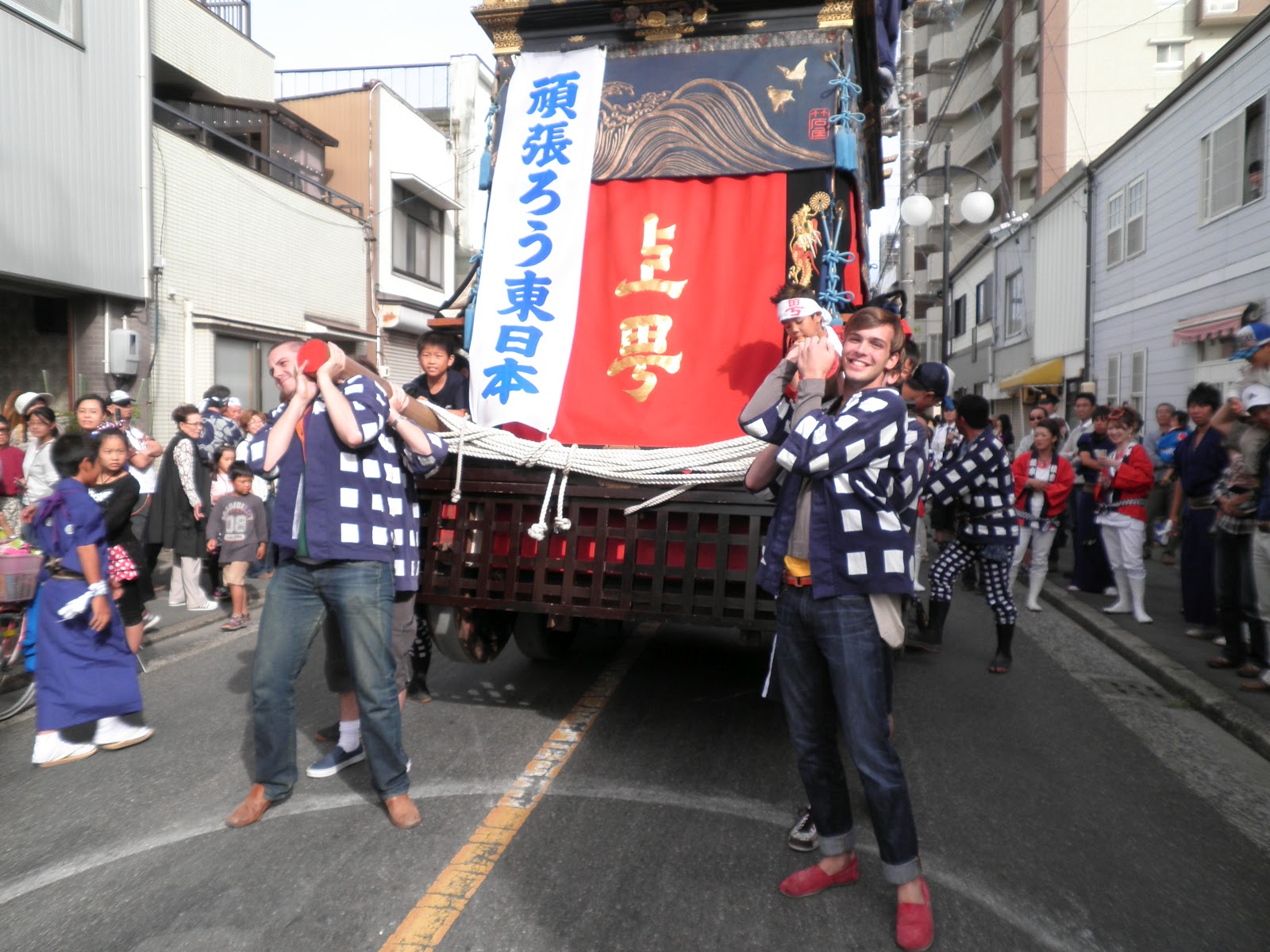
Another cool festival I went to was the Podunk Autumn matsuri 秋祭り. The festival's purpose is to appeal to the gods for good crops, particularly those of rice as the festival's timing is very close to that of the big rice harvest. In fact you can see the kanji character for rice, kome 米, on some of the ハッピ of the participants. At this festival, the shrines are contained within the dashi  山車 or 'mountain vehicles.' These elaborate wooden carriages are shaped much like a mountain with a couple of distinct tiers. Starting at the top, there is an area for a number of people to stand and sit. Up there are banners for the region from where the team hails, lanterns, decorations, and commonly, a huge doll in the shape of a priest. At times, the dashi are like mobile bunraku 文楽 (Japanese puppet theatre) shows at the top. The dolls themselves are controlled by the top tier inhabitants and they are sometimes made to throw confetti and I think rice too.


Going down, you will see the base of the mountain. This structure contains many intricately carved images if creatures (real and mythical) and plants. A bigger banner is usually attached (check out the photo). Housed within the central structure are many of the local children who periodically peek out pillbox style, claiming many victims through their drive-by of cuteness. Also housed at base level is a large taiko drum which is played throughout the day and particularly during the nighttime street parade. To the sides hang the traditional kane 鐘, metal cymbal/bell things that are played by girls and younger boys. The whole structure is set on 4 wheels and 2 wooden struts.


Podunk's claim to fame/originality is the practice of rotating the 山車. Just as there were many different teams in the Ohara Hadaka matsuri, the Podunk Autumn matsuri contains many teams from many regions within Podunk itself, and also from greater Aichi and neighbouring prefectures as I understood.


The dashi are towed around town and stop every now and then for, what I'll call, the rotation ritual. The men brace themselves for the hard work to follow, the kids peak their heads out in anticipation and the top tier inhabitants get ready to cheer and manipulate the puppet. The best place to see the rotation ritual is in the plaza outside the main train station. They are all spread out and it is easy to see the simultaneous spinning of a number of the 山車. The puppets are waving around, tossing confetti and the crowd is tripping over each other taking photos.

Upon the eventual march toward the Podunk Shrine, my "Japanese uncle" makes sure I and 3 of my foreigner friends get to take part, much to the curious delight of the locals. We are adopted into team Babacho, the region adjacent to the Podunk Shrine and which is made famous (locally) due to its old sacred tree. In a test of strength, we are asked to lift the front end of the heavy Babacho 山車, just the 4 of us. How do we fare? HINT: this is usually done by 6-8 men.... we FAIL. Though, we gather our chi and are very successful on the second try, hurrah! However, no time to celebrate as this is relatively easy compared to the rotation.


Soon after the warm-up act, we are tasked to rotate the 山車. It is an exercise in muscular endurance and ignorance of sustained, shoulder-crushing pain, especially if you've not much between your clavicle and ハッピ! We start out pretty well, our strengths vary a little as do our heights and positioning under the struts, so loads particularly with proximity to the vehicle and height of the participant. I am the tallest, so I got my fair share of the 'joy.'  I forget exactly how many turns are required, I'm recollecting anywhere from 8-12. When we started to go around, we were all surprised at the force we were working against, though we fight through the inertia and get it spinning.


The kids are cheering (maybe), the crowd is being sated and the local photographers are snapping away. We almost, almost complete the required rotations, but it goes down just short of the mark. We are encouraged and try once again and are better positioned and schooled. We get about 2/3 of the way through and are taught an interesting coping stratagem, "Look up and your pain will go away." So periodically we look up. How long before we realise that this is a hilarious placebo? I'm thinking that it clocked in at about 2 minutes, haha. Finally we get it around and then it is party o'clock. The onlookers applaud and our faces are beaming. Then we are offered a draught of deliciously blessed o-sake. They line us up one by one and I am literally lucky last, because being last, I got offered a double helping :D I was happy to oblige (read: indulge) and that garners more applause. What a fun time!


By night time the 山車 are mobilized once more with lanterns alight. In addition to the 山車 are some other lower set vehicles that also contain the taiko and kane. The drums and cymbals of traditional Japan beat and ring loudly across the town as the festival comes to an eventual close.


A really good time and I look forward to attending this year's installment later on in October.

Thursday, 17 November 2011

What is a Kappa?


Ye Olde Kappa depiction

Kon nichi wa my fellow Japan junkies. I was thinking that it is high time that I talk about one of this site's mascots, the Kappa. The Kappa is a prominent character in Japanese folklore, being counted as a member of the "lesser" water deities (perhaps lesser in terms of their standing in the deity hierarchy, but certainly not in terms of prominence in both scholarly literature and Japanese pop culture). The theories of the origins, physical features and malevolence/benevolence of Kappa vary quite a bit, so let me describe the common and most interesting image and traits of the green water imp.

The beak-ed Kappa kinda looks like a cross between a human and a turtle, sporting big claws, a shell, a scaly hide and an optional modesty-protecting loincloth. They have a rather smart green complexion of which there is debate to whether or not it is granted to them from eating their beloved food, cucumbers. Illustrations depict Kappa with anywhere from little to a lot of body hair, but despite this variance, the head is always seen crowned with a circumference of hair which surrounds a central water reservoir referred to as a 'sara' which is the same word used for plate/dish in Japanese. Contained within the Kappa's sara is its liquid life force, appearing as water and presumably so, though, scholars love to point out that nobody is 100% certain that the composition of the liquid is water. Pfft... why hedge your bets mates? It's a freaking water imp, of course it's going to be water!

Probably one of the most interesting parts of Kappa folklore is that of the strategy of stopping or defeating a Kappa. You see, the Kappa are known to be both benevolent and malevolent, and one of their many nefarious penchants, is that of springing from the water and seizing upon anything from a person (particularly a child) through to a horse in order to drag it to a watery grave where it will have a feast of its victim's organs, Bleech!. What? A little imp dragging a horse into the water... oh yeah, by the way the Kappa apparently has exceptional strength; what a boss! Must be all that basashi*. So should you encounter a pesky Kappa, legend says that, although it kinda wants to bite your head, it can be stopped in its tracks by giving it a polite bow. You see, though a Kappa doesn't bat an eyelid at killing the innocent, it nevertheless feels honour-bound to at least reciprocally bow at its future meal before declaring itadakimasu†. And right there is its undoing, as bowing causes it to spill its precious aqueous life force onto the ground, severely weakening it, and by some accounts, cause it to make an early exit to the, ermm, pearly cucumber fields in the sky.


Riverside Kappa warning signs, to this day, can still be seen posted about in order to ward children away by using cartoony images of scary water imps patiently awaiting a fatal misstep by little Kenichi-kun^ or Mariko-chan^. In fact, many people think that the Kappa were created purely as a tool to scare children from getting themselves into a potential drowning situation, a theory that I am a fan of.


But, let's hold up for a second, poor ol' Kappa are getting quite a bad rap here.They are known to be good too. The thing is, once a Kappa is made to make a promise to reform, it will with the utmost loyalty, hold true to its promise. There are a few situations where a Kappa will promise to come good. One such situation is when bargaining for their release from their captor. Another is when they wish the safe return of a severed limb...errr what?

Well, despite their livestock-towing strength, their limbs are prone to 'being liberated.' For example, it was (or is?) not particularly weird to see a horse running home to their owner with one or more Kappa arms lodged in their thigh. Upon the sight of this, farmer-san could, in the interests of their community, keep the arm for a future bargaining session as this presents a good opportunity to turn one or more of the local Kappas away from a life of crime. The Kappa will frantically seek out its divorced arm/s in order to reattach them within the few-day long window of time its body has the ability to do so. All of a sudden, I'm thinking that the villain, Cell, from Dragon Ball Z had some partial inspiration from Kappa folklore.

Capturing Kappas is an attractive venture because you can make them do work for you as payment for their release (and retribution for eating the local swimming squad). They are skilled healers, famed for their bone setting magics and ability to produce salves. They are also put to work in the fields and one has been known to help construct a drainage system on flood-prone farming land in old Edo, a deed offered as payment to a human that saved its life years prior. This area is in the vicinity of Kappabashi in modern Tokyo.

The word Kappa abounds in the Japanese lexicon. For example, 'Gappa' (from 'Kappa') is found in the term Gappadoki/ガッパドキ which is an old term for drowning that is apparently still used in some regions of Japan. 'O-Kappa' is a Kappa-like hairstyle, 'Kappa' refers to both the old straw-made and modern plastic poncho style raincoats and Kappa Maki is a type of sushi roll containing Kappa's favourite, cucumbers!
パー子ちゃん and カーくん


 Speaking of Kappa Maki, one of the most popular and iconic restaurants in Japan is Kappa Zushi/カッパ寿司. This chain of restaurants can be found in most Japanese cities, and of course, the flagship model of the restaurant is the cucumber sushi roll. The mascots for the restaurant, カーくん (Ka-kun) and パー子ちゃん (Pa-kochan) are a couple of cute water imps, presumably enslaved into servitude by an enterprising sushi chef.
カッパ巻き Kappa Maki

Kappa Tea, made from real Kappas!!!

Cutesy Kappa are now rife, seen in various pieces of merchandise, in manga, anime and video games, and of course, they are seen on this very website :D I have been personally assured that my Kanji-slinging sidekick is a vegetarian. Oh, the cucumber recipes he could tell you!!

Well there you are, the Kappa. If you are so inclined, there are many more legends about the Kappa to be found, such as the one of their fondness for sumo or their eternal hunt for the shirikodama (roughly translates to 'butt ball'..WTF). Yearrr, didn't want to write about that last one so much...

So to finish up, please enjoy some happy snaps of me and my friends when we found a Kappa out in 茶臼山 Chausuyama area, Aichi.


See you next time.
_______________________________
* basashi: horse sashimi / raw horse meat
† itadakimasu: phrase said before having a meal, literally meaning (I will humbly) receive
^ -kun and -chan are suffixes that are often and affectionately attached to children's names